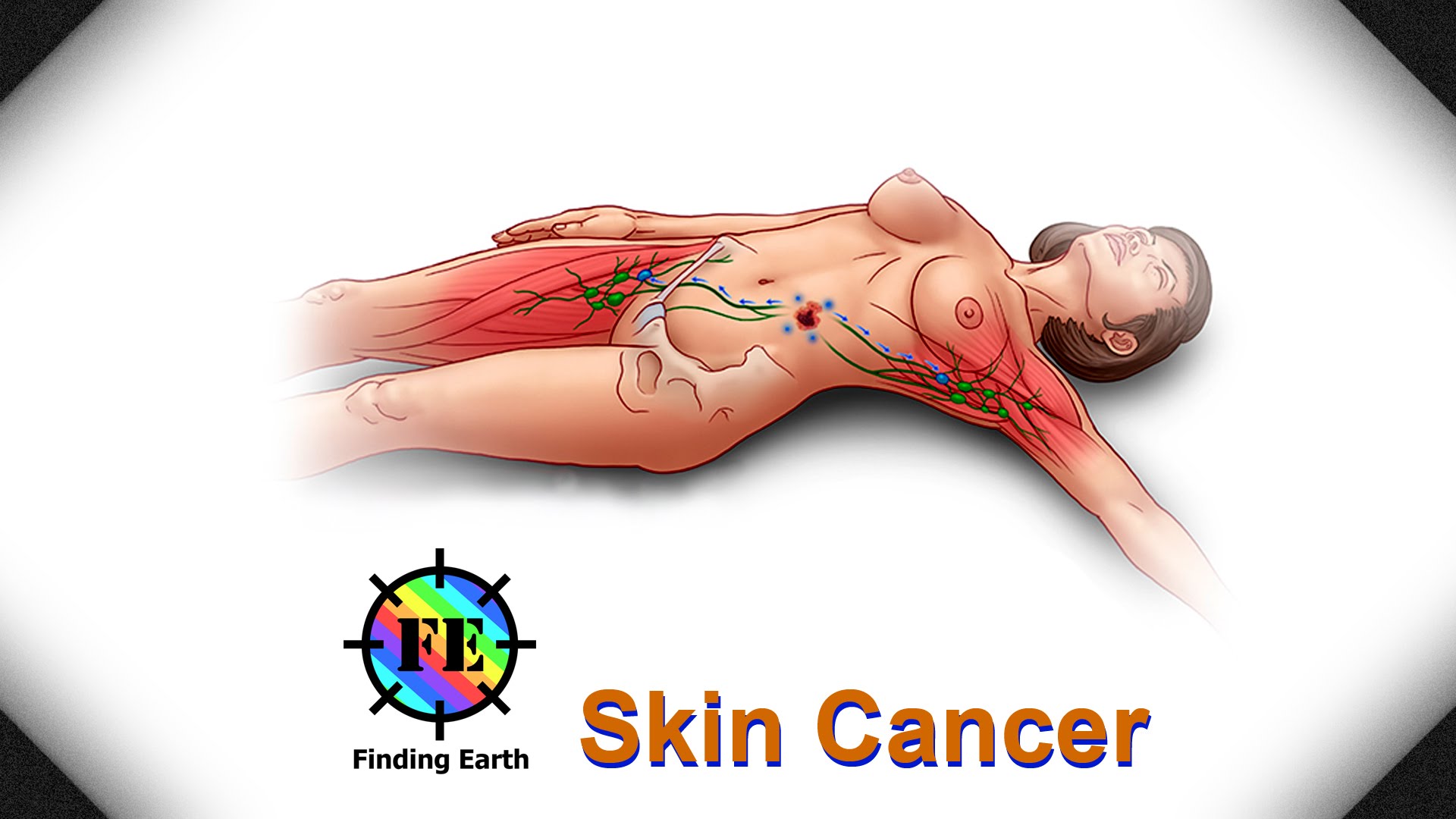
Skin Cancer – Symptom, Causes & Diagnosis (Finding Earth)
Skin cancer
There are three major types of skin cancers: basal cell carcinoma (BCC), squamous cell carcinoma (SCC), and melanoma. The first two skin cancers are grouped together as non-melanoma skin cancers.
Symptoms of skin cancer (non-melanoma)
Basal cell carcinoma
Squamous cell carcinoma
Bowen’s disease
symptoms of melanoma
The ABCDE rule : it is another guide to the usual signs of melanoma.
A is for Asymmetry: One half of a mole or birthmark does not match the other.
• B is for Border: The edges are irregular, ragged, notched, or blurred.
• C is for Color: The color is not the same all over and may include shades of brown or black, or sometimes with patches of pink, red, white, or blue.
• D is for Diameter: The spot is larger than 6 millimeters across, although melanomas can sometimes be smaller than this.
• E is for Evolving: The mole is changing in size, shape, or color.
Some melanomas do not fit the rules described above
Other warning signs are:
• A sore that does not heal
• Spread of pigment from the border of a spot into surrounding skin
• Redness or a new swelling beyond the border
• itchiness, tenderness, or pain
• Change in the surface of a mole – scaliness, oozing, bleeding,
Causes of skin cancer
Most skin cancer is caused by ultraviolet (UV) light damaging the DNA in skin cells. The main source of UV light is sunlight.
types of UV light:
• ultraviolet A (UVA)
• ultraviolet B (UVB)
• ultraviolet C (UVC)
Increased risk
Certain factors are believed to increase chances of developing skin cancer, including:
• pale skin that does not tan easily
• blonde hair
• blue eyes
• older age
• a large number of moles
• a large number of freckles
• a condition that suppresses your immune system, such as HIV
• past History of skin cancer
• skin cancer in the family
• radiation exposure
• A weak immune system
• Human papilloma virus (HPV)
Exposure to Chemicals like
• Coal tar
• Soot
• Pitch
• Creosote
• Petroleum products, such as mineral oil or motor oil
• Shale oils
• Arsenic
Other skin conditions
Psoriasis
Solar keratosis
Xeroderma pigmentosum
Gorlin’s syndrome
Birthmarks
some types of birthmark in the outer layer of skin can increase the risk of developing a type of skin cancer called basal cell carcinoma (BCC).
Diagnosis
Medical history and physical exam
Usually the first step the doctor takes is to get a medical history. During the physical exam, your doctor will note the size, shape, color, and texture of the area(s) in question, and whether they are bleeding, oozing, or crusting.
Skin biopsy
If the doctor thinks a spot might be a melanoma, a sample of skin will be removed from the suspicious area and sent to a lab to be looked at under a microscope. This is called a skin biopsy.
Shave biopsy
Punch biopsy
Incisional and excisional biopsies
Fine needle aspiration biopsy
Surgical lymph node biopsy
Sentinel lymph node biopsy
Chest x-ray
This test may be done to help determine whether melanoma has spread to the lungs.
Computed tomography (CT) scan
The CT scan uses x-rays to make detailed, cross-sectional images of your body. Unlike a regular x-ray, CT scans can show the detail in soft tissues (such as internal organs).
CT-guided needle biopsy: CT scans can also be used to help guide a biopsy needle into a suspicious area within the body.
Magnetic resonance imaging (MRI) scan
Like CT scans, MRI scans give detailed images of soft tissues in the body. But MRI scans use radio waves and strong magnets instead of x-rays to create pictures. A contrast material might be injected, just as with CT scans,
Positron emission tomography (PET) scan
A PET scan can help show if the cancer has spread to lymph nodes or other parts of the body. It is most useful in people with more advanced stages of cancer
Blood tests
Blood tests aren’t used to diagnose melanoma, but some tests may be done before or during treatment, especially for more advanced melanomas.